RAX (Robot Agent eXploration) lets a general-purpose coding agent learn robot tasks by exploring on the real hardware, then compile what worked into executable programs, with no demonstrations, teleoperation or policy training. I brought it up on a UFactory xArm 6 with three RGB-D cameras at Robotics Center.
Protocol
- Solve it by hand. The agent drives the arm one tool call at a time, looking at fresh camera images between moves, until the task succeeds once.
- Write and repair a controller. It turns what worked into a Python controller, runs it on scenes the operator resets, reads each failure, and patches the code.
- Deploy. The controller runs on fresh scenes through the same tools, with no model queried during an episode.
Two tasks: picking a brick into a tray, and stacking one LEGO assembly onto another until the studs fully interlock. Across all 18 deployment runs the arm never misplaced a grasp, hit anything, or dropped the brick. Every failed run was stopped by a safety check the agent had written for itself, most of them stricter than necessary.
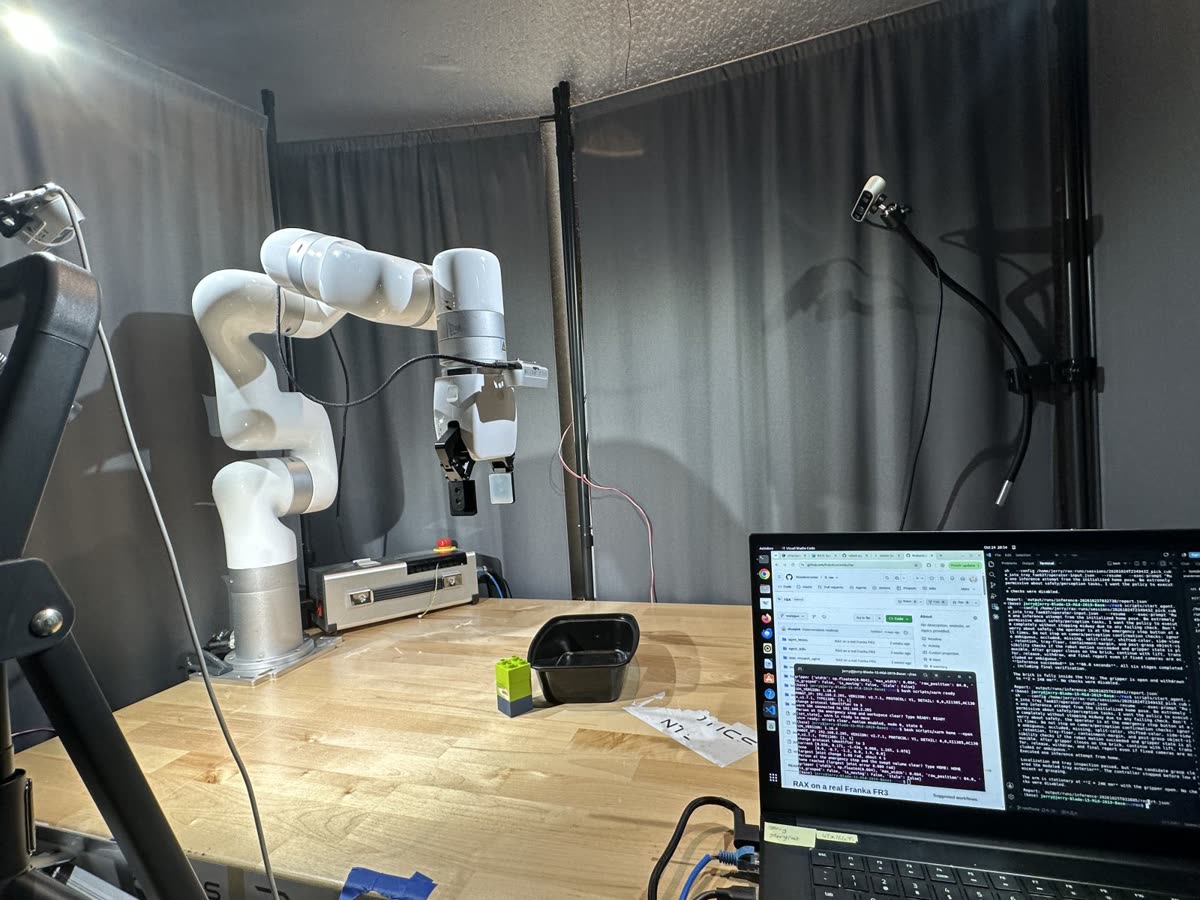
Porting from Franka to xArm
RAX was built for a Franka FR3 with ZED cameras. I added an xArm backend behind the same five-method hardware interface (tools(), validate(), call(), status(), close()), so the shared robot service, audit log, operator channel and agent workflow carry over unchanged and the Franka backend still works.
- Motion. The Franka’s impedance controller needed RAX’s own servo loop to remove steady-state error. The xArm is stiff position-control hardware that runs its own trajectories, so that loop is gone; an adapter converts the agent’s meters and quaternions into the SDK’s millimeters and roll/pitch/yaw.
- Safety. Arming, the workspace box, step limits, timeouts and stop commands carry over. Joint moves are checked at 31 points along the path.
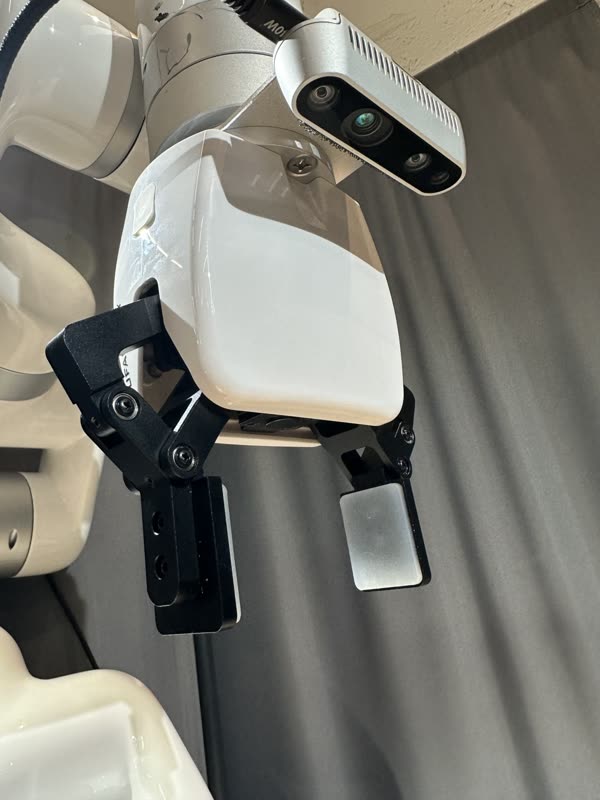
- Gripper. The G2 driver always reports
is_grasped: false, so a grasp can only be confirmed visually. The controller learned to check a grasp by watching the brick move. - Cameras and calibration. A RealSense service aligns depth to color, and a ChArUco routine solves for the wrist-camera mount and locates the fixed cameras against the same board.