Problem statement
Transcript-only RAG fails on lectures in a predictable way. The professor says “as you can see here”, and the answer is on the slide. Slide-text-only RAG fails the other way, because the slide says “Figure 3” and the explanation is spoken. We wanted one retrieval method that combines all 3 modalities.
Method
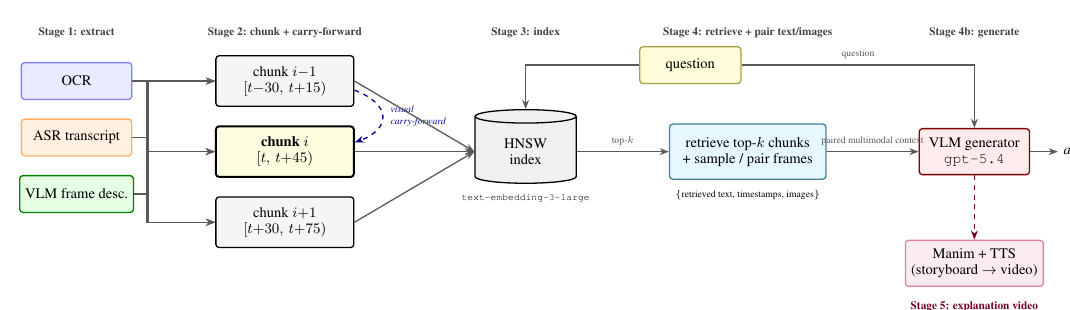
- Extract 3 natively timestamped streams: OCR on frames sampled every 2 s, ASR, and VLM descriptions of each frame. A pHash change detector re-runs OCR and the VLM only when the frame changes materially. This removes most of the redundancy in slide-driven lectures.
- Chunk by time. Tile each lecture into \(45\) s windows with \(15\) s overlap, and concatenate the 3 modality-tagged blocks.
- Visual carry-forward. A slide that appeared just before the window started is still on screen, but it contributes no OCR row to the window. So each chunk also gets the latest OCR row and frame description from before the timestep, deduplicated against the in-window content.
- Retrieve with one dense vector per chunk (
text-embedding-3-large), either across the whole course or filtered to the lecture the student is watching. Then generate with a VLM given the chunks and their frames. - Render the answer as a narrated
manimvideo, with an agent harness to catch visual, programmatic, and semantic errors.
Results
We hand-annotated 156 questions across COGSCI C127, DATA 100, and CS 288 in 7 categories: text, images, tables, charts, complex layouts, motion, and audio. Each question has a time window marking where in the lecture the answer appears.
| Course | No context (GPT-5.4) | Global retrieval | Lecture-filtered |
|---|---|---|---|
| DATA 100 | 20.4% | — | 82.0% |
| COGSCI C127 | 32.7% | — | 58.8% |
| CS 288 | 63.0% | 79.6% | 83.3% |
LLM-judged accuracy, best setting per course. The full table is in the paper.